

In December of 2017 FindBiometrics surveyed over 200 members of its informed audience – including executives from the world’s leading biometrics companies – on topics relating to the identity technology industry over the past 12 months. The results comprise the 15th Annual FindBiometrics Year in Review.

The past year in biometrics was marked by dynamism. Major product releases, major acquisitions, major controversy and major deployments brought biometrics further into the mainstream than ever before, while challenging the status quo and setting the foundation for an even more active 2018.
Among the major shifts in industry attitudes was the popularity of individual modalities. As in previous Year in Review Surveys, we asked our respondents:
In Your Opinion What Was The Most Exciting Biometric Modality in 2017?
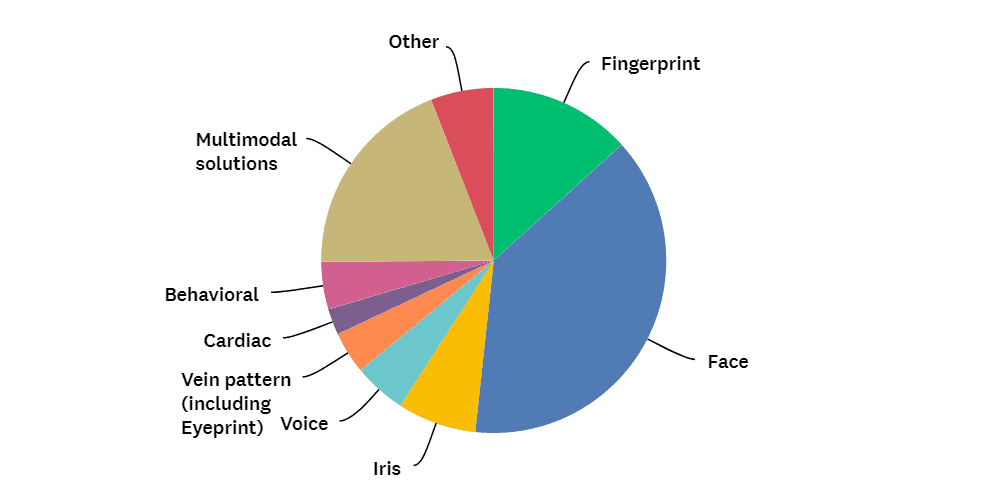
 The results were unlike any we have seen in our annual Year in Review. Face biometrics was the most popular choice, voted most exciting by 38.4 percent of respondents. In second place, we see multimodality (defined as any combination of the listed mono-modalities) voted most exciting by 19.2 percent of respondents, and fingerprint dropping to third most exciting with 13.3 percent of the vote. Rounding out the remaining third we saw iris (7.4 percent), voice (4.9 percent), behavioral (4.4 percent), vein pattern (3.9 percent), and cardiac (2.4 percent), with 5.9 percent of votes for other non-listed modalities.
The Year of the Face
While it’s not entirely surprising that facial recognition was deemed exciting by our readers, it is remarkable that the modality holds the top spot in these results by such a huge margin. In our previous survey for 2016 the face modality came in as third most exciting, overshadowed by a tie for first place between fingerprint and multimodal solutions.
 The initial instinct when looking at these results is to point to the iPhone X. 3D Facial recognition is the only biometric authentication factor on Apple’s luxury class smartphone. High profile and controversial, Apple’s Face ID decision directly affected the mobile biometrics market. Reports emerged in the wake of the Face ID announcement stating that mobile device OEMs were predictably aiming to emulate the newest iPhone (just as they imitated Touch ID in 2013), and as such, fingerprint sensor manufacturers saw a decrease in demand for their product, which given the state of the technology nearing year’s end, was incapable of accommodating full size smartphone displays without compromising placement and cost (the rear-mounted sensor configuration is less popular than front-facing home button implementations, and less expensive to boot). Indeed, near the end of the year we saw announcements indicating that facial recognition was being included as an authentication feature on Android phones.
So it’s safe to say that Apple played a part in facial recognition wave of excitement in 2017, but its top position isn’t all residual Apple Effect.

The technology itself has simply matured to a point that inspires greater confidence in face as a modality. Gone are the days of disabling the face-unlock feature on your Android device because it is too insecure. Bolstered by machine learning and artificial intelligence, mobile solutions like Sensory’s TrulySecure and FaceTec’s ZoOm are making quality mobile facial recognition widely available beyond Apple’s top tier handset.
Beyond consumer devices, in 2017 facial recognition software rose up as the solution of choice for remote enrollment. Combined with document recognition technology, face biometrics powered solutions like Jumio’s Netverify, which enables remote Know Your Customer compliance via what it calls Trusted Identity as a Service (TIaaS). The ability to verify identities with biometrics and identification documents using just a phone is a powerful tool in the sharing economy, government applications, financial services, cryptocurrency, and more. And it’s not just market potential: Jumio’s remarkable sales numbers in Q3 of 2017 prove face-powered solutions like this are in high demand.
Related Year in Review Coverage:
‘Face is the Future’: Our Year in Review Interview with NEC North America’s Raffie Beroukhim
 As the Internet of Things continues to expand, so too does the ability to deploy facial recognition in public for reasons of safety, security, and novelty. China truly embraced facial recognition in public space throughout 2017, deploying the technology to catch wanted criminals a a beer festival, to crack down on cheaters in marathons, to protect toilet paper at a park, and to sell fried chicken.
And, of course, all of these new reasons to be excited for facial recognition are held up by a strong foundation of past use cases that have evolved along with the modality. Facial recognition continued to be deployed as a mobile authentication factor for banking, as we saw in September when HSBC embraced FacePhi’s technology enabling selfie-based login. Face biometrics tech was used in contactless physical access and border control too, and it enabled naked payments in some high profile demonstrations. Furthermore, thanks to its software-based nature, it is still a staple of Biometrics-as-a-Service platforms targeting the enterprise market.
While the modality was still the subject of privacy-focused controversy in some areas, like social media, it is clear now, at the dawn of 2018, that familiarity with facial recognition is helping dispel some of the technology’s long held stigma, replacing it with excitement.
*
Join us on Monday as we look back on the news and events that defined the second most exciting modality of 2017. Stay posted to FindBiometrics throughout January as we continue to analyze the 15th Annual Year in Review survey results.
The 15th Annual FindBiometrics Year in Review is brought to you by Leidos.
—
January 11, 2018 – by Peter B. Counter