FaceTec has delivered a security update for its recently launched UR Code solution that its engineers believe will provide a cryptographic safeguard that will last for the next decade. The UR Code protocol now supports Ed25519, a digital signature algorithm based on elliptic curve cryptography that is known for being fast, secure, and efficient.
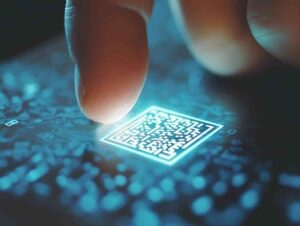
The significance of the development stems from the UR Code’s uniquely effective approach to irrefutable identity verification. First unveiled last September, the UR Code essentially encodes an individual’s biographic and biometric data into a scannable QR code, which can then be matched to the QR code holder with a simple face scan. Because the biometric and biographic data are inextricably linked in the QR code, matching the person’s face to the code proves the data on the code pertains to them.
That all depends to some extent on cryptography, which ensures that the information encoded in a given UR Code can’t be altered—by changing the name of the UR Code holder, for example.
That becomes very difficult with Ed25519, which is a modern public-key cryptography algorithm designed for creating digital signatures. It’s a part of the EdDSA (Edwards-curve Digital Signature Algorithm) family and is built on a specific elliptic curve called Curve25519.
In cryptography, an elliptic curve is a mathematical structure used to create public-key encryption systems that are highly secure yet efficient. Elliptic Curve Cryptography (ECC), including Ed25519, leverages the complex properties of these curves to perform encryption, digital signatures, and key exchanges with smaller keys and faster processing compared to traditional methods like RSA.
Ed25519 is known for being fast, secure, and efficient, making it ideal for use in applications like FaceTec’s UR Codes, where quick, secure verification is essential. And by embracing Ed25519, FaceTec has implemented support for a fast and highly secure kind of cryptography that has been used in other sophisticated systems like the secure messaging app Signal, the software development platform Git, and in Virtual Private Networks whose business model depends on protecting user privacy.
It is also recognized in the National Institute of Standards and Technology’s SP 800-186 specification, establishing it as an appropriate solution for use in U.S. Federal Government cryptographic systems. That could help to foster adoption of UR Code credentials by and within government agencies.
“Adding the NIST-approved Ed25519 elliptic curve future proofs the security of UR Codes until at least 2035,” commented Josh Rose, FaceTec’s Chief Technology Officer. “We look forward to adding support for even more asymmetric encryption curves over the next few years.”
The solution’s announcement comes just a couple of weeks after the appointment of Nicole McNamee-Wicks as FaceTec’s new Director of Biometric Cybersecurity, who is tasked with helping to lead the adoption of UR Codes among state and federal governments. It should help her to make the case for the protocol as various agencies consider digital-first identity solutions.
It also arrives after last week’s launch of the UR Code “Scan+Match” app for mobile devices. Available for Android and iOS, Scan+Match actually puts UR Code-based identity verification into the hands of end users, enabling them to scan a code and match it against the code holder’s face.
–
February 19, 2025 – by Alex Perala