

Welcome to the latest edition of the AI Update, where we continue to track the major developments in artificial intelligence and their implications for identity security and cybersecurity more broadly.

Anthropic has postponed the release of its next frontier AI model because of its cybersecurity risks. The model, dubbed “Mythos Preview”, is just exceptionally good at hacking. In a blog post, Anthropic explained that the model “has already found thousands of high-severity vulnerabilities, including some in every major operating system and web browser.” To address the security risks ahead of release, Anthropic has launched “Project Glasswing”, which comprises a series of partnerships offering early access to Mythos so that participants like Apple, Google, and JPMorganChase can make sure their systems are ready for whatever Mythos-powered attacks may come once the model becomes widely available.
In fact, despite the ongoing public dispute between Anthropic and the Pentagon, the company has been briefing senior government officials about Mythos, apparently prompting Treasury Secretary Scott Bessent and Federal Reserve Chair Jerome Powell to hold a meeting with major bank CEOs about the potential security risks they may face from Mythos’ release.
The UK government, meanwhile, is trying to woo Anthropic to build up its presence there, seeing an opportunity in the Pentagon dust-up. Among other things, the UK government is preparing a proposal for dual listing on the London Stock Exchange, with outreach being coordinated by the Department for Science, Innovation and Technology. Previously, under the leadership of Rishi Sunak’s Conservative government, the UK had attempted to position itself as an AI hub. But its efforts floundered, and the recently elected Labour government had cancelled a planned £800 million exascale supercomputer at the University of Edinburgh within months of taking office.
On that note, OpenAI has put its Stargate UK data center project on hiatus, citing energy costs and a volatile regulatory environment. OpenAI said it “continues to explore Stargate UK and will move forward when the right conditions such as regulation and the cost of energy enable long-term infrastructure investment.” It’s not all about the UK, though: OpenAI has been shifting its compute build-out strategy away from a focus on financing and building its own infrastructure and toward renting capacity from hyperscalers such as AWS and Google Cloud.
SpaceX has posted a net loss of about $5 billion for 2025 as a result of its merger with xAI, helping to illustrate the enormous training costs of the latter’s AI models as CEO Elon Musk races to catch up with the other leading AI companies. Reuters had previously reported that SpaceX generated roughly $8 billion in profit on $15 billion to $16 billion in revenue in 2025, prior to the merger. The news comes as Musk seeks to dramatically revamp xAI after the departure of all 11 of its other co-founders.
Meta has expanded its AI cloud relationship with CoreWeave via a new $21 billion contract that will run through December of 2032, building on an earlier $14.2 billion arrangement signed last September. The agreement is meant to help ensure that Meta gets access to additional cloud-computing capacity and Nvidia’s Vera Rubin chips as it, too, races to catch up with the major AI players. After poaching various other labs’ talent with huge paychecks last year, Meta this week revealed a major new AI model, Muse Spark. On the standard benchmarks, it wasn’t a leap to the head of the pack, but it showed solid progress on the part of Meta’s “superintelligence” team.
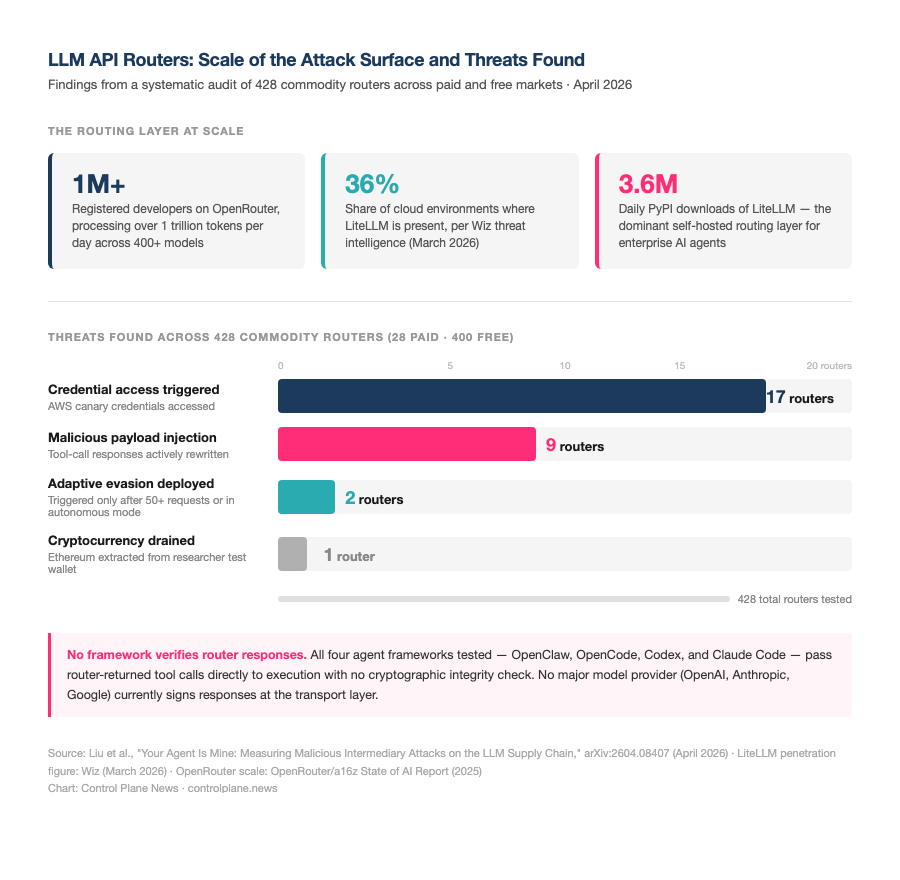
A new paper from a team led by UC Santa Barbara researchers details serious potential security risks from the use of LLM routers – third-party services that enable access to AI models like Claude, ChatGPT, and many others. In an audit of 428 routers, they found 17 that accessed sensitive AWS credentials embedded in test environments, and nine that re-wrote tool-call responses used by AI agents. One even emptied a test crypto wallet. The findings hint at some serious issues, including potential agent identity attacks, when such routers are used.
The findings were neatly illustrated in a piece published on Control Plane, our recently launched sister site focused on AI security issues:
–
By Alex Perala


