

Welcome to the newest edition of ID Tech’s AI Update. Here’s the latest big news on the shifting landscape of AI and identity technology:

The major news this week revolved around ongoing fallout from Anthropic’s dispute with the US Department of War. Anthropic did not meet Secretary of War Pete Hegseth’s Friday evening deadline last week to agree to the DoW’s terms for the use of Anthropic AI in war-related activities, and as a result it was formally blacklisted – a measure normally reserved for companies from America’s adversaries.
Anthropic immediately said it would sue over the “supply-chain risk” designation, and followed up yesterday with a statement from CEO Dario Amodei. “As we stated last Friday, we do not believe, and have never believed, that it is the role of Anthropic or any private company to be involved in operational decision-making—that is the role of the military,” he wrote. “Our only concerns have been our exceptions on fully autonomous weapons and mass domestic surveillance, which relate to high-level usage areas, and not operational decision-making.” He added later that the designation “doesn’t (and can’t) limit uses of Claude or business relationships with Anthropic if those are unrelated to their specific Department of War contracts,” and Microsoft has apparently already come to the same conclusion, announcing that it would keep selling Anthropic tech to clients outside of the DoW.
Meanwhile, OpenAI swept in to scoop up a DoW AI contract valued at up to $200 million. Initially, CEO Sam Altman indicated that his team and the Pentagon were very much aligned with respect to ethical safeguards on how its AI technology will be used. But a few days later he backtracked somewhat, and said that OpenAI was trying to finesse some details of the agreement. “The issues are super complex, and demand clear communication,” Altman said. He also seemed to acknowledge a growing backlash around the optics of OpenAI’s move. “We were genuinely trying to de-escalate things and avoid a much worse outcome, but I think it just looked opportunistic and sloppy.”
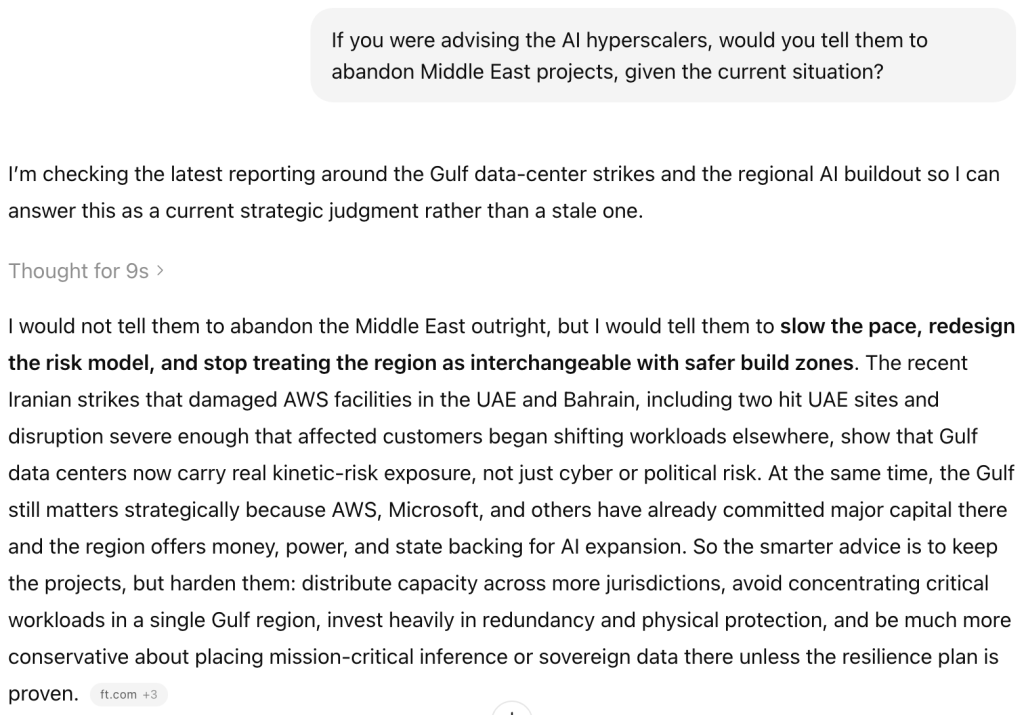
And while all this was playing out, the Department of War launched attacks on Iran, whose retaliation included drone strikes against Amazon Web Services data centers in Bahrain and the UAE. The structural damage included power disruptions, fire-related water damage, and longer-than-normal outages affecting AWS customers. But it could turn out to be more than physical: Several Middle East countries have been pitching themselves as safe AI cloud hubs for hyperscalers like Amazon, Microsoft, and OpenAI. Their reputation could take a hit, though Big Tech’s infrastructure needs are so profound that they may be willing to risk a few drone strikes as they continue their AI buildouts.
On that note, AI-focused cloud computing startup Together AI is in talks to raise about $1 billion at a $7.5 billion pre-money valuation, which would more than double its $3.3 billion valuation from over a year ago. The “neocloud” provider rents out Nvidia-heavy compute infrastructure to AI developers that need cloud infrastructure, access to GPUs, model training, and inference services. Together AI’s annualized revenue has reportedly tripled since last summer to around $1 billion, and it is increasingly buying, not just leasing, Nvidia chips.
US-based Broadcom reported a 106 percent year-over-year jump in Q1 AI revenue, at $8.4 billion, and expects a 140 percent increase for Q2 of 2026. The company is benefitting from demand for custom AI chips, as well as its ability to ship Google’s seventh-generation Ironwood TPUs. And CEO Hock Tan has reportedly told investors that Broadcom had secured capacity of leading-edge wafers and high-bandwidth memory through 2028.
AI ‘world model’ startup Embo is in talks to raise over $100 million in its seed round. That’s huge by normal startup standards. The company was co-founded by former Google DeepMind researchers Danijar Hafner and Wilson Yan, and is focused on interactive, three-dimensional AI-generated world models that could be used to train robots.
OpenAI is working on a “bidirectional” audio model that would power more naturalistic interactions with AI chatbots. Instead of taking the usual “you talk, then I talk” turns, the “BiDi” model would be able to speak and listen at the same time, allowing for more seamless interruptions and conversational flow. Which, of course, means that AI-powered agents could sound even more like humans on voice calls in the near future.
The chatbot’s take: A bit of geopolitical corporate strategizing from GPT-5.4:
–
By Alex Perala


