

Welcome to the newest edition of ID Tech’s AI Update. Here’s the latest big news on the shifting landscape of AI and identity technology:

SoftBank has agreed to take a ~2 percent stake in Intel, with a commitment to purchasing about $2 billion worth of newly issued common stock. The move comes in the wake of reports that the White House is in talks to take a 10 percent stake in the company as part of its efforts to strengthen America’s position in the global AI race. SoftBank chairman Masayoshi Son described his firm’s investment as a “vote of confidence” in Intel’s legacy and its critical role in expanding US semiconductor manufacturing.
SoftBank has also acquired Foxconn’s 6.2‑million square‑foot Lordstown, Ohio facility for about $375 million, with plans to turn it into a production hub for AI servers and data center equipment tied to the massive $500 billion Stargate project in partnership with OpenAI and Oracle. Foxconn, meanwhile, will continue operating the facility under a new joint venture, solidifying the Taiwan-based firm’s foothold in US AI infrastructure.
Anthropic has reportedly doubled its latest funding round from a target of $5 billion to $10 billion to meet investor demand. The round is said to be led by Iconiq Capital, with other expected contributors including TPG, Lightspeed Venture Partners, Spark Capital, and Menlo Ventures. Sovereign wealth funds from Qatar (QIA) and Singapore (GIC) are also in discussions to participate.
Crusoe Energy Systems is in talks to raise about $1 billion in a combination of equity and debt financing. The Denver-based company specializes in AI data centers powered by clean energy. The investment round would value the company at $10 billion – a major jump from its $2.8 billion valuation attained last year.
Axelera AI is reportedly in talks to raise over €150 million (around $175 million). The firm is a Dutch startup backed by Samsung Electronics and the European Union, and focused on AI Processing Units (AIPUs) tailored for robots, drones, automotive systems, medical devices, and smart security cameras.
Meta is once again reorganizing its AI lab, announcing that Meta Superintelligence Labs (MSL) will be split into four divisions – Research, Product & Applied Research, Infrastructure, and TBD Lab. This is Meta’s fourth major reorganization of its lab since February, and comes after a spree of talent-poaching from rivals. Most division heads will report directly to Chief AI Officer Alexandr Wang.
Meanwhile, Meta has finalized a six‑year cloud services agreement with Google Cloud valued at over $10 billion. The deal grants Meta access to a wide suite of Google Cloud infrastructure, including servers, storage, networking, and AI compute capacity. Meta has previously maintained its own global data centers and partnerships with AWS and Azure. The new arrangement represents its first large-scale infrastructure contract with its AI rival Google.
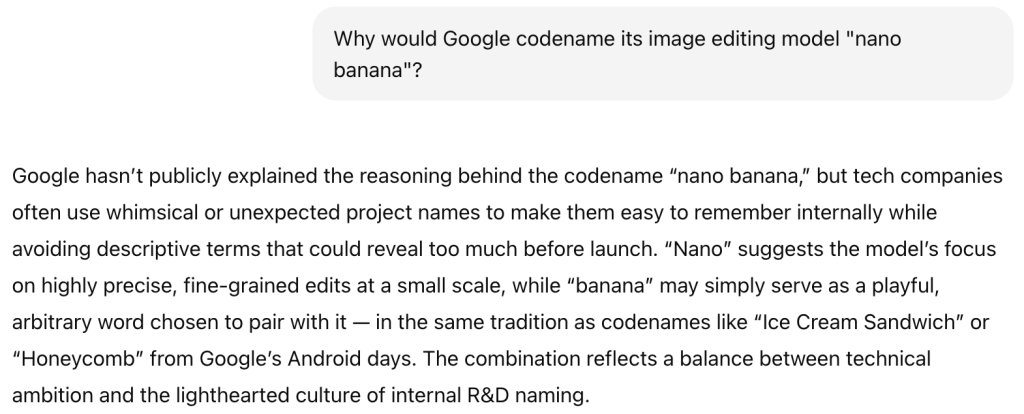
Google has developed an extremely capable image editing model that allows users to conversationally ask for changes to pictures, such as “remove the person standing to my right.” The model, codenamed “nano banana”, started raising eyebrows when it appeared on the LMArena benchmarking platform ahead of Google’s launch event for its next-generation Pixel 10 smartphones.
Nvidia has directed key suppliers to halt production of its H20 AI chip, which is designed specifically for the China market. Regulatory authorities in China have raised security concerns, and Cyberspace Administration of China had earlier summoned Nvidia to answer questions about possible “backdoor” capabilities in the chip. Suppliers Samsung (memory components), Amkor (advanced packaging), and Foxconn have all been ordered to suspend production as Nvidia CEO Jensen Huang has denied any such security issues.
The chatbot’s take: Apparently the Google AI team is quite whimsical.
–
By Alex Perala


