

Welcome to the newest edition of ID Tech’s AI Update. Here’s the latest big news on the shifting landscape of AI and identity technology:

Nvidia had a crazy quarter, announcing a 73 percent jump in revenues for Q4 of its fiscal 2026. Sales came in at $68.1B, with net income amounting to $42.96B. Regular readers may sometimes wonder why I so often include these blockbuster earnings reports (so do I, sometimes). This is a good illustration of why: given the centrality of Nvidia in the AI ecosystem, the report shows that AI infrastructure spending is structurally unstoppable. As CEO Jensen Huang put it, “Compute equals revenues. Without compute, there’s no way to generate tokens. Without tokens, there’s no way to grow revenue.”
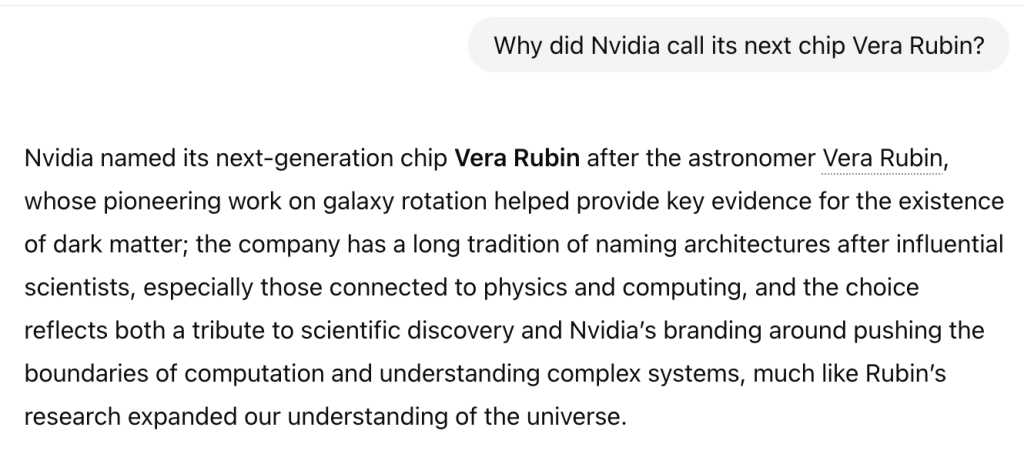
On that note, Nvidia offered a first look at Vera Rubin, its next-gen AI chip, which offers a 10x performance improvement over its predecessor, Grace Blackwell, and is expected to ship in the second half of this year.
U.S. Defense Secretary Pete Hegseth gave Anthropic a deadline of 5:01 p.m. on Friday to loosen the safety guardrails of its Claude AI platform, or else face being blacklisted for U.S. government work. The crux of the issue is that Anthropic refuses to let Claude be used for weapons control and the surveillance of American citizens. In a statement issued Thursday evening, Anthropic CEO Dario Amodei said: “We cannot in good conscience accede to their request. The contract language we received overnight from the Department of War made virtually no progress on preventing Claude’s use for mass surveillance of Americans or in fully autonomous weapons. New language framed as compromise was paired with legalese that would allow those safeguards to be disregarded at will.” The original ultimatum was reported by Axios.
The White House has summoned major AI companies for a “Ratepayer Protection Pledge” summit focused on making sure they are accountable for rising costs resulting from demand for electricity. Amazon, Google, Meta, and OpenAI will be among the attendees of the March 4 event and signing ceremony with President Donald Trump.
A coordinated pro-Russia campaign used deepfake videos of Hollywood celebrities to pressure European leaders toward signing a peace deal to end the Ukraine conflict on terms favorable to Russia. Meanwhile, voice clones have passed the “indistinguishable threshold,” according to University at Buffalo professor Siwei Lyu, who runs the school’s Deepfake-o-Meter lab. Some major retailers are reporting getting over a thousand AI-generated scam calls per day.
OpenAI has closed a $110 billion funding round, bringing its pre-money valuation to $730 billion – a considerable jump from the $500 billion valuation attained in October of last year. Among the investors are Nvidia and SoftBank with $30 billion investments apiece, and Amazon, which pitched in $50 billion as part of a major expansion of their pre-existing cloud and AI training partnership. Notably, $35 billion of Amazon’s investment is contingent on OpenAI either achieving AGI (artificial general intelligence) or making its IPO by the end of this year.
Google has announced the launch of Nano Banana 2, the latest version of its highly popular image generation tool. According to Google, it can maintain character consistency for up to five characters in a single workflow, and users can make very nuanced requests for alterations to their images. What’s more, the system can actually search the web for relevant details to a given image prompt – so for example, something set in a particular park could prompt Nano Banana 2 to search for more information about what that park actually looks like. If that sounds like a recipe for deepfake disaster, you might take some comfort in the fact that Google’s SynthID invisible watermark is present in every image generated, so there is a way to definitively identify when an image has been created using Google AI technology.
The chatbot’s take: What’s up with the new chip name?
–
By Alex Perala


