

Welcome to the newest edition of ID Tech’s AI Update. Here’s the latest big news on the shifting landscape of AI and identity technology:

Netflix has sent ByteDance a cease-and-desist letter over AI videos generated by its Seedance 2.0 platform. A number of videos generated by the sophisticated system have gone viral on social media, in part thanks to its apparently total lack of restrictions with respect to likenesses and the repurposing of creative IP. In its letter, Netflix highlighted “unauthorized depictions of Season 4 content” from its TV series Bridgerton as well as “high-fidelity reboots of the series finale” of Stranger Things, among other examples.
Raspberry Pi shares have seen a meme stock-like surge in the wake of speculation about its technology’s role in agentic AI systems. Open source platforms like OpenClaw allow enthusiasts to run AI agents on their own computers, and Raspberry Pi specializes in the kind of low-cost single-board hardware that can run them. “AI on the Pi” chatter helped to drive a 42 percent surge in share prices over a couple of days in mid-February, with one analyst observing that Raspberry Pi computers offer “‘good enough’ functionality at near-zero incremental cost”.
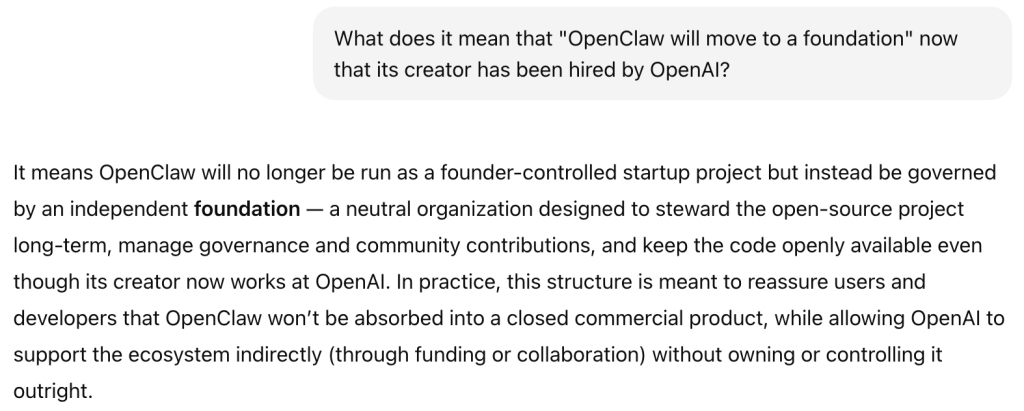
And the guy who invented OpenClaw has now been hired by OpenAI. In announcing the move, OpenAI CEO Sam Altman explained that Peter Steinberger will “drive the next generation of personal agents”, and for his part, Steinberger explained that rather than heading his own company, he’d rather help pursue the future of AI agents at OpenAI while keeping OpenClaw open source. “OpenClaw will move to a foundation and stay open and independent,” he wrote.
OpenAI is reportedly finalizing the first commitments to an anticipated $100 billion financing round that could give the company an implied valuation in the $830 billion to $850 billion range. The round is thought to be anchored by major strategic and financial players (notably Nvidia, SoftBank, Amazon, and Microsoft, among others), and is strongly linked to OpenAI’s projected infrastructure buildout and compute spend through the end of the decade. OpenAI has told investors it plans to spend around “$600 billion on computing resources through 2030”.
Humain has disclosed it invested $3 billion in Elon Musk’s xAI as part of xAI’s Series E round, a deal that made the Saudi Arabian state-backed AI company a “significant minority shareholder” and, following Musk’s subsequent corporate move, resulted in Humain’s xAI stake being converted into SpaceX shares. As with OpenAI’s big new funding round, the Series E tied Humain’s investment to Musk’s AI roadmap and to the compute-and-infrastructure buildout that Humain and xAI have been discussing since late 2025, including reported plans linked to 500 megawatts of AI data-center capacity.
Sequoia Capital is reportedly leading a $1 billion seed round for Ineffable Intelligence, a London-based AI venture founded by former Google DeepMind researcher David Silver. The startup will focus on developing “superhuman intelligence” through reinforcement learning – essentially, getting an AI system to learn by interacting with an environment and receiving rewards or penalties depending on its success. Silver is associated with major DeepMind breakthroughs including AlphaGo and AlphaStar, and is now also a professor at University College London.
The UK Government Office for Science has published a case study describing a “world-first deepfake detection evaluation framework” led by the Home Office with multiple UK departments and partners, including the Accelerated Capability Environment, DSIT, DCMS, HMRC, and the Alan Turing Institute. The UK government funded a “Deepfake Detection Challenge” hosted by Microsoft, with over 350 participants, including teams from law enforcement and the Five Eyes intelligence-sharing community. The exercise used high-pressure, time-sensitive scenarios tied to national security and public safety. It hasn’t yet led to any breakthroughs, but the Government Office for Science says the “hackathon-style event helped assess a range of UK and international based solution-providers and is another leap towards strengthening the UK’s overall ability to deal with synthetic media.”
The chatbot’s take: A bit of clarity about what’s going on with OpenClaw now that Steinberger got snapped up by OpenAI:
–
By Alex Perala


